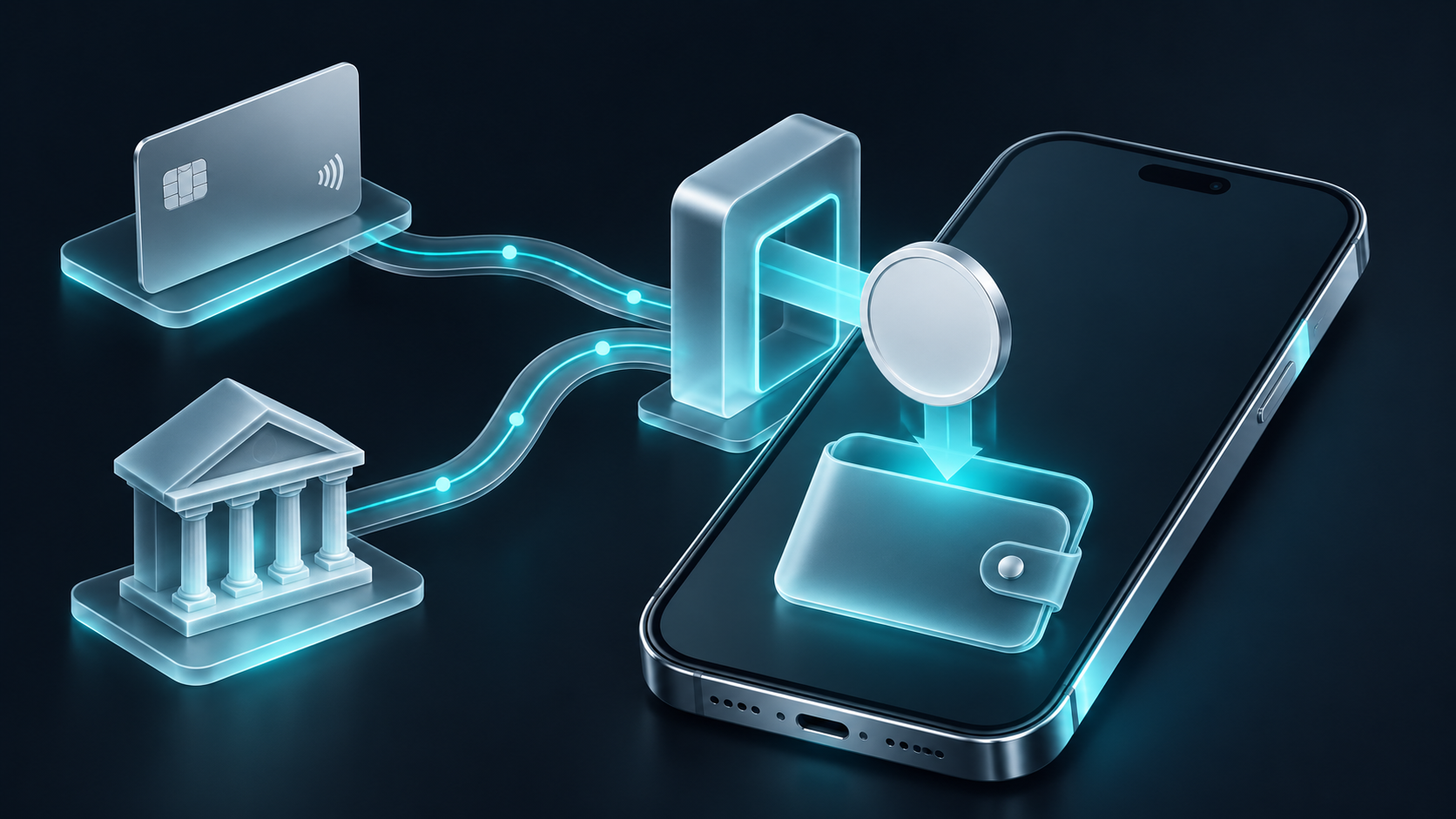
Buying a stablecoin no longer has to start with a crypto exchange. On 5 November 2026, Stripe said its Crypto Onramp was powering USDC purchases in the new Samsung Wallet Stablecoin Account for eligible users in the United States.
Stripe says the account is available across 82 million compatible Galaxy devices in the US. That number describes a potential device footprint. It does not mean 82 million people opened an account, bought USDC or used a blockchain. Stripe announcement
The development is nevertheless important: a familiar phone wallet can become the front door to a digital dollar, while the crypto infrastructure operates further in the background.
What the integration actually does
According to Stripe, eligible users can buy USDC in the Samsung Wallet Stablecoin Account using Samsung Pay, credit or debit cards, and ACH. Stripe's Crypto Onramp supplies the purchase infrastructure.
Think of the experience as a chain of distinct jobs:
- The wallet interface presents the account and actions to the user.
- The onramp handles the process of buying the stablecoin through supported payment methods.
- USDC is the dollar-referenced stablecoin obtained in the transaction.
- The blockchain network carries supported onchain transactions where the product uses it.
Samsung had previously described USDC transfers on Solana as part of its US rollout. The Stripe announcement concerns the purchase onramp; a supported purchase, a transfer and a merchant payment are different actions, each with its own terms. The Block on Samsung's earlier announcement
Why a familiar wallet changes distribution
A crypto product usually asks people to learn several new concepts at once: an exchange, a wallet, a network, a token and sometimes a recovery phrase. Embedding a stablecoin account in a familiar application can reduce the number of new steps a user sees.
That does not automatically create demand. A person still needs a reason to buy or transfer USDC: perhaps an eligible payment or transfer use case, depending on the product's supported features. An app installed on a device is a distribution opportunity, not evidence that its users are active customers.
The integration also creates a competitive question. If money movement becomes a feature inside an existing phone wallet, users may compare the full experience — eligibility, fees, exchange rates, support and speed — rather than choose a network first.
USDC is not the same thing as a bank deposit
USDC is a stablecoin designed to maintain a value close to one US dollar. Owning it is not identical to holding dollars in a bank deposit, and the legal claim, protections and operational risks depend on the product and providers involved. The value can deviate from its target, and transactions can involve fees or network-specific restrictions. Circle on USDC
Likewise, seeing a balance in a wallet does not by itself tell you who controls the assets. Read the account terms to establish the custody model, identity requirements, availability, transfer options and what happens if a device or account is compromised.
Card funding can also carry different costs and limits from a bank transfer. Compare the full amount charged with the USDC received, not just the advertised token price.
The questions that matter for adoption
The 82 million device number is a starting point for evaluating reach. It does not answer the harder questions:
- How many eligible users actually activate the account?
- How often do they buy, transfer or use USDC after the first transaction?
- What does a transaction cost after funding, conversion and any network fees?
- Which states, devices and users are eligible under current terms?
- Where can the balance be used, and what happens when something goes wrong?
Those answers matter more than a large addressable-device number. Public announcements do not necessarily disclose them.
The bigger shift
Samsung and Stripe illustrate a distribution model in which users encounter stablecoins through an established consumer product. The technology may become less visible, while the need to understand custody, fees and protections remains.
If the experience is useful enough for repeat transactions, the account could widen access. If it remains an occasional feature on compatible devices, the headline footprint will overstate practical adoption. The next milestone to watch is measured usage, not another estimate of reach.
Information checked 9 November 2026. Availability and fees can change; consult current provider terms.