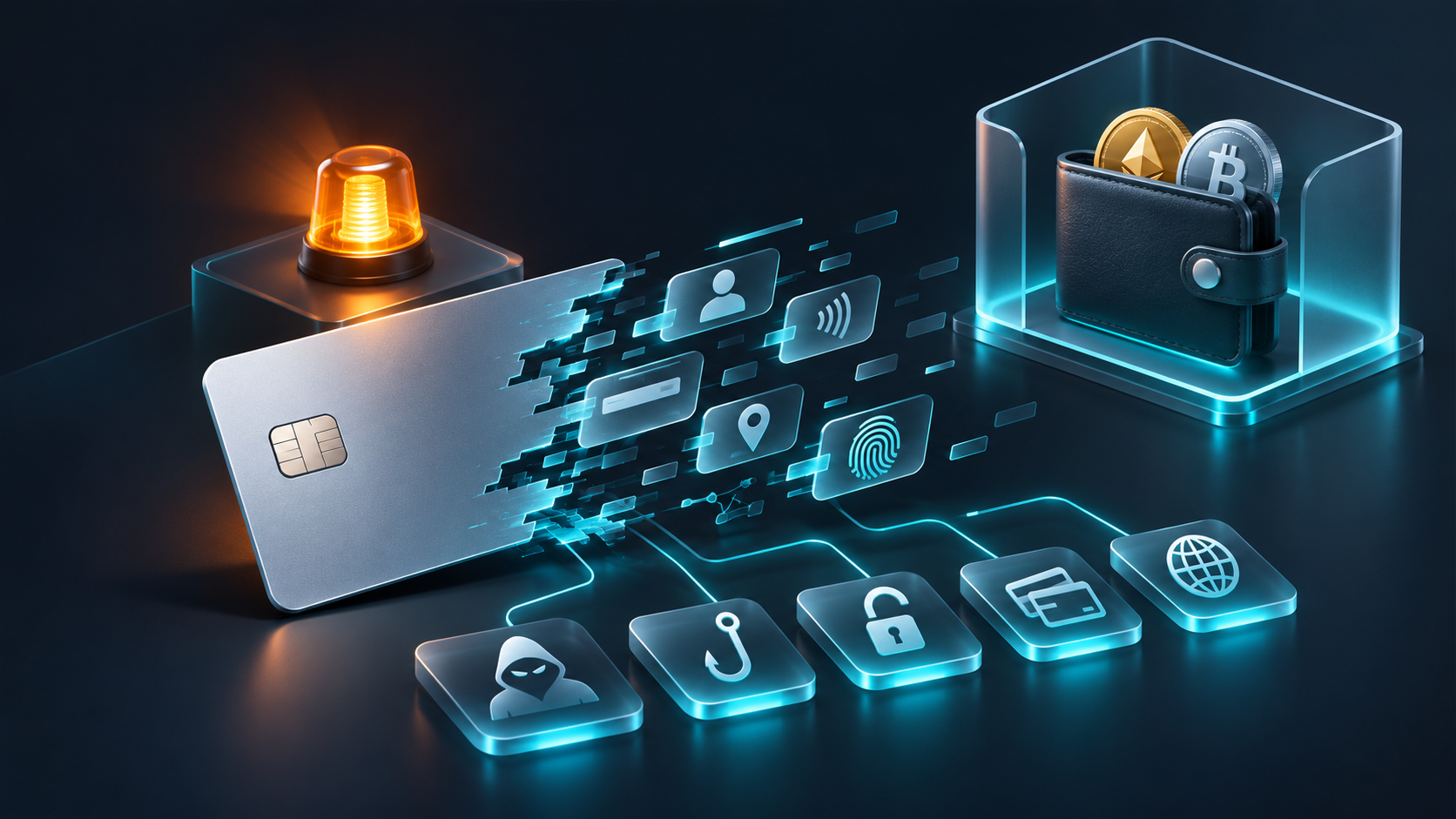
A crypto wallet can protect the keys to your assets while another company stores your card details and personal information. If that company's systems are breached, the financial and privacy consequences can be serious even if the wallet itself is untouched.
On 3 November 2026, Gnosis Pay says it detected unauthorized access to the legacy system powering Gnosis Pay-branded cards. The company says its separate enterprise platform was not affected. Its account of the incident is the primary source for the distinctions below; the number of affected customers and an independent audit were not established in the material reviewed. Gnosis Pay incident update
One product, several security boundaries
A crypto card can combine an app, a card program, service providers and a wallet. Each component may handle different information or permissions. A failure in one layer should not automatically be described as a failure in every layer.
Card information can be used for attempted unauthorized card transactions. The right response may involve freezing or replacing the card and monitoring activity.
Personal information can make targeted phishing more convincing. A criminal who knows your name, address or relationship with a provider can craft a message that appears more credible.
A wallet address is generally public, but linking it to a real identity can expose transaction history and create privacy or targeting risks. Exposure of an address alone does not give someone the private key.
Private keys or recovery phrases can give control over a wallet. A card-data incident is not proof that these secrets were exposed; equally, no general description of a card breach should be read as a guarantee that a particular wallet is safe.
What Gnosis Pay reported
Gnosis Pay said unauthorized access affected the legacy card system and that it responded after detecting the incident. It also introduced mandatory 3D Secure for online card payments while preparing to retire its consumer system. Consult the company's current incident page and direct account communications for the exact data categories, affected services and latest instructions. Gnosis Pay incident update
The distinction matters: the company's statement about the incident is not independent proof of every underlying detail, and the absence of an announced wallet loss does not eliminate card fraud or identity risk. Avoid treating a short headline as a complete incident report.
If you may be affected, check these five things
- Open the provider's app or type its official address yourself. Do not rely on a link in an unsolicited message claiming to be support.
- Review card activity. If you see an unfamiliar transaction, use the official freeze or block controls and contact the card issuer through a verified channel. Ask about replacement and dispute procedures.
- Check account security. Change a reused password, enable available strong authentication and review security notifications. Do not give a one-time code to someone contacting you unexpectedly.
- Expect follow-up phishing. A real name, card detail or wallet address in a message does not authenticate the sender. A caller asking you to move funds urgently is a warning sign.
- Never share a recovery phrase or private key. Support does not need either to investigate card activity. Do not connect or sign a wallet transaction merely because a message says it is needed to secure an account.
If you already entered credentials or signed a transaction, contact the relevant provider immediately through its official support route and follow its current incident instructions. The appropriate wallet response depends on what was exposed; do not assume a card replacement alone resolves a compromised recovery phrase.
The lesson for crypto users
Self-custody changes who controls the keys. It does not make every app, card issuer or identity database around a transaction self-custodial. Before using a crypto payment product, ask which companies hold your data, who can block a card, which accounts can access the wallet and how you would reach support without clicking a message.
The best security model separates these risks. That makes it easier to respond to the actual incident instead of either dismissing exposed data or assuming that every breach means all onchain funds were stolen.
Based on the company's incident description available on 9 November 2026. Check official updates for changes and account-specific instructions.