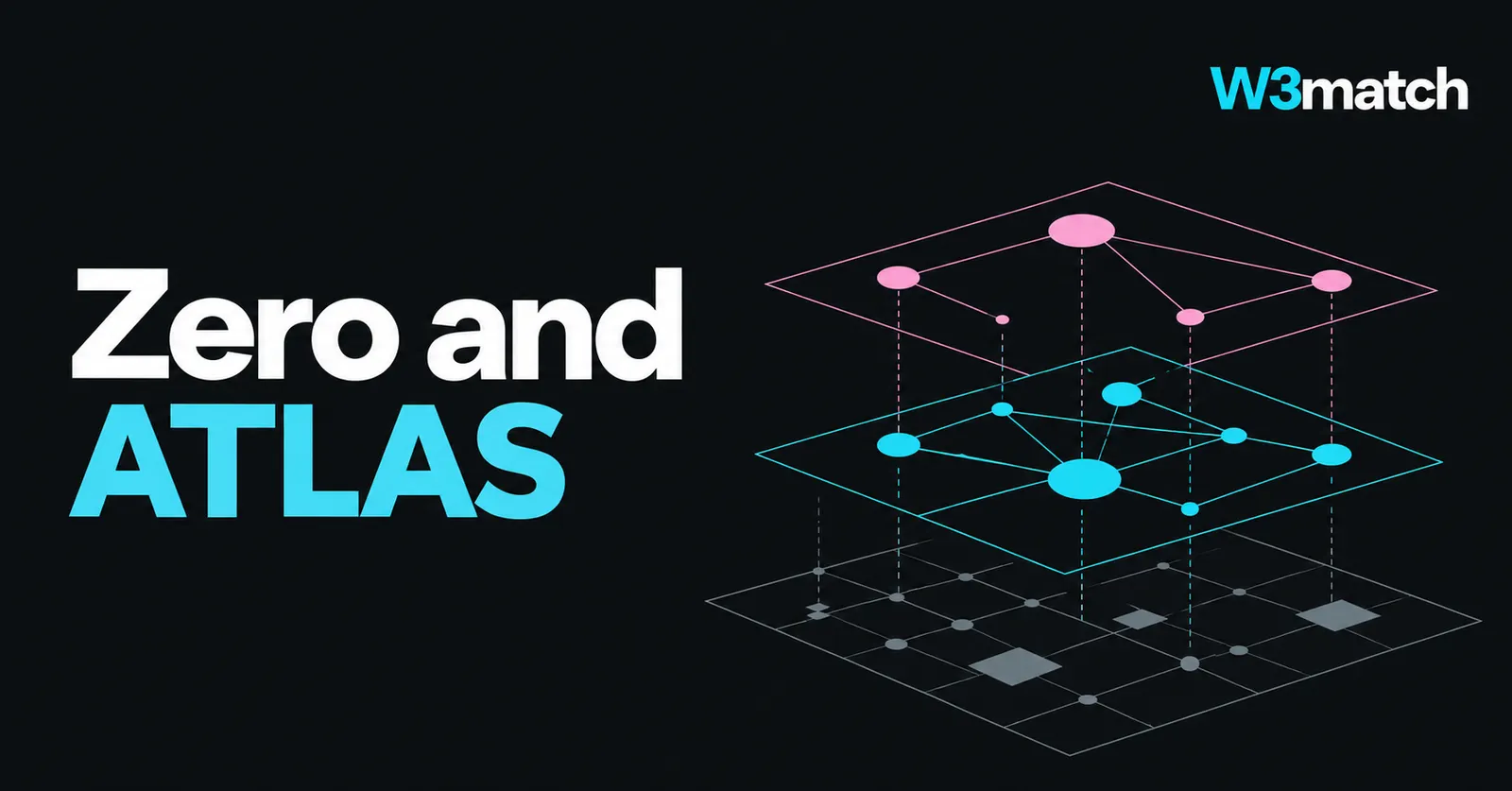
Zero is LayerZero's blockchain design; ATLAS is its announced headless exchange engine. Trading venues would supply the customer interface while ATLAS handles matching, clearing, settlement and risk. LayerZero's messaging protocol is a separate part of the stack. The article distinguishes this announced design from verified production adoption.
The material reviewed on October 13, 2026 establishes an announced design and published demonstrations. It doesn't establish independently verified production trading volume, venue profitability or ATLAS-funded token burns. The sections below explain the design and the evidence that would make it an operating business thesis.
Separate the names first
LayerZero's messaging protocol connects applications across networks. Zero is a separate blockchain architecture designed to host workloads. ATLAS, short for Aggregated Trading Liquidity and Settlement, is a headless exchange engine intended to run on Zero.
“Headless” means it has no consumer trading frontend of its own. A venue would bring the application and distribution while using ATLAS underneath. Market creators would define markets, and firms supplying quotes would provide liquidity. ATLAS resources and model.
This matters commercially. A venue connecting to another exchange's backend may compete with that exchange's own interface. ATLAS proposes a backend relationship in which the venue retains the user experience and receives a share of trading fees.
The name also has a potential trap. Anchorage uses Atlas for its own settlement product. That is a separate system. Its activity cannot be counted as LayerZero ATLAS adoption merely because the names match. Anchorage Atlas.
The venue rebate is deducted first
Open ATLAS announced economics, illustrated with $100 of gross fees and a 20% venue rebate.
Illustrative calculation using the announced split. Not observed revenue, an executed purchase or a guaranteed production arrangement.
Announced ATLAS economics
What Zero changes in the design
Zero separates execution work from verification. Its description assigns workload execution and proof generation to block producers, with validators checking proofs rather than repeating all the computation. Separate Zones are intended to let different workloads run concurrently. Zero overview.
For a trading venue, the attraction is capacity during bursts of activity. A market move can create orders, cancellations and position updates together. Average activity during a quiet hour says little about the system's behavior at that moment.
The open question is the complete production system. Proof generation, data availability and the cost of running the specialized components can affect performance and participation. A validator checking a proof cheaply doesn't by itself establish that every role in the system is cheap to operate.
I would look for measurements across those roles rather than a single headline number. The architecture is interesting because of how it divides work. Its practical value needs evidence from the deployed system.
ATLAS combines the market workflow
Trading involves more than agreeing on a price. Matching pairs a buyer and seller. Clearing determines obligations. Settlement records the resulting ownership. Risk controls determine whether participants can keep trading as their exposure changes.
ATLAS proposes bringing these functions into one backend. Its August 25 announcement also describes open and institutional configurations. A regulated venue would still need to set the market rules and investor access appropriate to its business. Introducing ATLAS.
For tokenized securities, the issuer relationship still matters. The venue needs a valid asset, permitted holders and a workable claim on the underlying product. An engine matching a stock-themed instrument doesn't automatically give the holder ordinary shareholder rights.
That makes asset quality and market plumbing complementary. A fast system with poor asset definitions can produce fast disputes. The RWA ownership guide provides the questions to ask before an instrument enters the order book.
A performance demo needs its boundaries
LayerZero's October 5 demonstration illustrates a stated 200,000-transactions-per-second capability. It is a project-produced throughput visualization, not a live dashboard of customer trades. The 200K TPS demo.
The unit deserves attention. Orders, cancellations, matches and settled trades are different events. Comparing two TPS figures requires knowing what each system counts and under what conditions it runs.
Latency has the same problem. An order acknowledgement can be fast while final settlement follows a different timeline. A benchmark in a controlled or colocated environment shouldn't be described as every user's end-to-end experience over the internet.
Useful evidence would name the workload, hardware, network conditions and measurement point. It would also show behavior during congestion and failure. For a trading business, reliability under stress can matter more than a median result in the best environment.
The fee split is worth calculating
ATLAS's announcement describes a venue rebate, then allocates the remaining fee pool: 25% to the market creator and 75% to buying and burning ZRO. For Open ATLAS, venue rebates range from 20% to 65%, linked to stake and/or volume. These are stated design terms, rather than verified production distributions; they shouldn't be assumed to define every institutional arrangement. ATLAS economics.
The order of that calculation matters. The ZRO allocation applies after the venue receives its rebate. It doesn't mean 75% of every dollar of gross trading fees reaches token purchases.
For an illustrative $100 fee pool, a 20% venue rebate leaves $80. Applying the stated split allocates $60 to ZRO purchases and burns. At a 65% rebate, $35 remains and the ZRO allocation is $26.25. These are arithmetic examples, not revenue forecasts or observed trades.
The interactive calculator accompanying the article lets you change the hypothetical fee pool and venue rebate. It deliberately asks for gross fees rather than inventing a fee rate or trading volume. Actual economics require the deployed schedule and executed allocations.
Volume is only one input
A high-volume venue can have low fees, large rebates or heavy incentives. The amount available for ZRO depends on those terms and on whether the buy-and-burn process actually runs.
A full evaluation should distinguish fee-paying customer activity from internal or subsidized trading. It should also compare gross fees with the resources required to run the system. A published allocation formula doesn't settle the long-term operating model.
ZRO's proposed roles in Zero add another set of inputs. The design describes gas, delegated staking and venue-related stake. Each role should be measured separately rather than rolled into one claim that adoption must increase price. Zero and ATLAS relationship.
For the existing LayerZero ecosystem, some revenue-driven ZRO purchases are already reported through Stargate. Those purchases are a separate mechanism from future ATLAS burns. Our value-capture article keeps their ledgers separate.
What would move the thesis forward?
I would watch for a named production venue with verifiable trading, a published fee schedule and an identifiable allocation of proceeds. The next evidence would be repeat use by customers and a first ATLAS-funded ZRO burn that can be tied back to the fees.
Then I would ask whether venues keep using the backend after launch incentives fade. The headless model is attractive if it gives distributors useful economics and dependable infrastructure. Retention is evidence that the relationship works for both sides.
For RWA adoption, verify the exact assets and holder rights available in those markets. The value of tokenized securities on other networks can't be counted as ATLAS volume without a trade taking place through the engine.
The architecture offers a plausible business route: venues can outsource infrastructure while maintaining their customer relationships. The investment case becomes stronger when that route produces measurable, repeatable economics. Until then, the fee formula tells you what to monitor. It doesn't supply the revenue.