Dataset scope: This is a historical analysis of the August 2026 genesis campaign, using the post-cleanup action snapshot taken on August 24 at 17:26 UTC. Counts describe the retained dataset. Network patterns can suggest coordination; they cannot establish private agreements or intent without additional evidence.
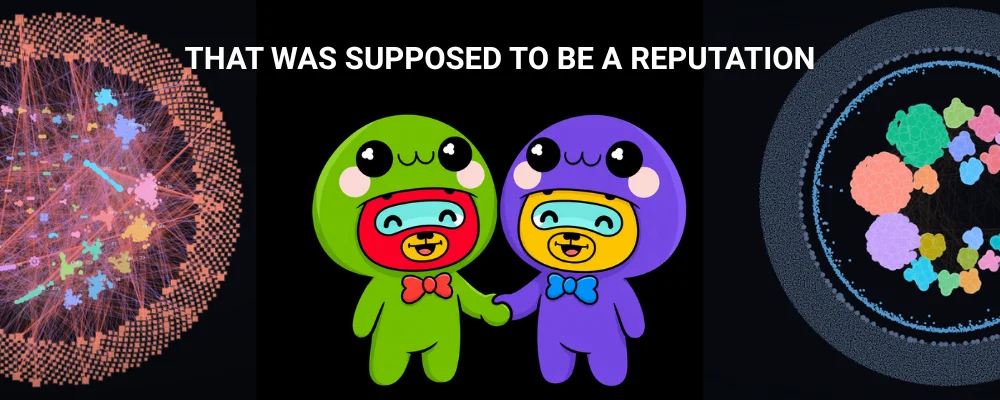
In August 2026, a project called Commons opened with a question that sounds like philosophy and turned out to be engineering: "What would an airdrop look like if you could only give it to others?"
commonsmade.com/vouch21 Aug 2026View on X
The rules fit in three lines. Every participant got seven vouches and seven slashes, not seven per day but seven for the entire season. Spending one meant posting a public tweet naming one other account. A vouch moved 35% of your own score onto somebody else's total. You got nothing for it. The slot was gone permanently.
That design deserves a moment of respect, because the rest of this article is about what happened to it. In almost every points campaign ever run, the way to win is to spend effort on yourself. Commons made that structurally impossible. You couldn't buy your own standing at any price, and the only path upward ran through somebody else's decision to spend a scarce, unrecoverable resource on you. A scarce endorsement is costly to send. Whether it reflects genuine regard, a negotiated swap or another incentive has to be tested against the observed behavior.
Ninety thousand accounts signed up. Over four days, 60,578 of them performed 199,974 irreversible acts: 183,415 vouches and 16,559 slashes. Every one is public, timestamped and attributable. I pulled all of them into a graph, which is where most of the numbers in this piece come from.
Every vouch, slash and community in the genesis season, as an interactive map of 60,578 accounts.
Open the Commons GraphWithin a day, there was a market.
Not a metaphorical one. Participants started trading vouches directly, and 19,170 pairs ended up vouching each other. 2,121 of those pairs closed in under sixty seconds. A return inside a minute is consistent with advance coordination, but fast timing alone does not establish a private agreement. Alongside the barter came contracts ("vouch me and I'll share 50% of my airdrop"), then cash, with one participant distributing 400 codes worth $3 each in exchange for vouches, and finally a secondary market where somebody paid $30 for thirty thousand points and received an $18 airdrop. The one resource carefully designed to be unpurchasable was being purchased within twenty-four hours.
That's the first thing this season demonstrates, and it travels well beyond crypto. Making a resource unspendable on yourself doesn't make it non-transactional. It moves the transaction off the ledger. The constraint didn't prevent trade. It created a currency.
The second thing takes both halves of the record to see. I have the complete ledger of what 60,578 accounts did, and I have the public conversation that ran alongside it: every announcement, argument, plea and apology. Most studies of online behaviour have one or the other. Having both is uncomfortable, because they disagree. The account that founded a Telegram group for punishing those who do injustice never used a single slash. The most-slashed account of the entire season, hit 1,146 times, never struck back once. And when 145 accounts coordinated to destroy three targets, three of them said so publicly. An analysis built on posts alone would have found three people. The ledger finds a hundred and forty-five.
The third thing is the one that stayed with me. The mechanism was built to reveal who deserved the airdrop. What it revealed, with a timestamp on every transaction, is who already had somebody. The single most-vouched account received 1,942 vouches, not from a campaign but from a private community he'd been building for years. One member noted the invite had come three years earlier. Of that community's roughly 197 members, 82 finished in the top 1,000, about forty times the baseline rate. Meanwhile 36,344 accounts spent their vouches and got nothing back. They weren't outplayed. They showed up without a network, in a game that could only measure one.
None of this makes Commons a failure. The design was thoughtful, the campaign was by the admission of participants who lost money on it one of the most effective marketing operations crypto Twitter had seen in years, and the mechanism worked exactly as specified. It just measured something other than what it was pointed at. That gap, between what a mechanism is designed to detect and what it can actually detect, isn't a crypto problem. It's the problem with every reputation score, every peer-review system, every community vote, and every attempt to make merit legible by making it countable.
The campaign ended on 24 August at 17:00 UTC. Four and a half hours before the close, vouching and slashing were frozen entirely while the team fought bots. The token launched at a $4 million valuation, the first airdrop was set at 0.5% of supply, and within twenty minutes somebody had done the division in public: twenty thousand dollars, split a thousand ways. Twenty dollars each, for three days of work, against an expectation anchored on a comparable project that had paid around $3,500. The winner of the leaderboard gave his entire allocation away in a giveaway of ten prizes at $30, which means the winner's raffle paid better than actually finishing in the top thousand.
And then, from an account that finished 80th out of ninety thousand, that received 96 vouches, spent all seven of her own, and got not one of them back, came the only assessment in the entire record that reads like it was written from outside the game:
空投虽没鲁到,但是我撸到了人情。
"I didn't farm the airdrop. I farmed rénqíng."
人情, rénqíng, is the web of obligation, favour and goodwill that constitutes durable social standing in Chinese social life. She used the same verb everyone had been using all week for farming points, and changed the object. She's the only person among the 36,344 unreciprocated givers who said anything at all afterwards, and what she said was that she'd received the thing the mechanism was built to measure, had noticed it, and considered the trade worth making.
What follows is an attempt to take that seriously.

PART I: THE EXPERIMENT
Three lines of rules
The mechanic went live on 21 August at 17:28 UTC. The scarcity constraint arrived as a reply rather than an announcement, which meant plenty of people met the main post first and never saw it: "PS; you only get 5 vouches and 5 slashes. Use them carefully."
Five each, later seven. A vouch adds 35% of your base score to somebody else's total, a slash removes the same amount, and your own number never moves. The clearest participant explanation landed thirteen hours into the campaign and ended with the right observation: "Your own score doesn't move. 👀 That changes the incentive completely."
That changes the incentive completely.22 Aug 2026View on X
It does. Consider what the design rules out. You can't farm. You can't buy your way up, because there's nothing for sale that affects your own score. You can't grind harder than everyone else, because the budget is identical for a wallet with a million followers and a wallet with nine. The only input to your position is other people deciding you're worth one of their seven permanent slots.
Compare that to every other attention game running at the same time. Kaito pays you for posting. Points programs pay you for transacting. Both reward volume, which means both reward whoever can afford the most volume. Commons made volume irrelevant and made judgement the only currency. As a piece of mechanism design, it's genuinely clever, and I want that on the record before I spend seven thousand words on what went wrong.
One detail matters more than it looks. The budget changed mid-campaign. On 22 August, "Everyone should give more, 2 more to be exact" raised the allocation from five to seven. The tweet went out at 19:36 UTC. The vouches themselves had appeared in people's dashboards roughly four hours earlier, which you can see in the discovery tone of the first participant to notice at 15:41: "Finally, they listened to us and gave us 2 more Vouches 🔥." Nobody responds to an announcement with "finally, they listened." They respond that way to finding something in their account.
So a silent rollout landed around mid-afternoon, and the announcement followed four hours later. In between, people who'd already spent everything suddenly had assets again, and every negotiation in progress reopened. If you're reading reciprocation timings from this campaign, that boundary matters, because the population before it and the population after it aren't the same.
What the record actually contains
Two sources, and they check each other.
The first is the action ledger: every vouch and slash, with author, target, timestamp and point value. 60,578 accounts appear in at least one action. That's the object I turned into a graph, and it's the source for every count in this piece that isn't attributed to a tweet.
The second is the public conversation, pulled from a social analytics index covering the campaign window. That's where the quotes come from.
The reason to trust the combination is that they were assembled independently and they agree on specifics. @Bakioption posted that he'd finished at "rank #1,004 | 694,756 points" with thanks to "the 80 people who successfully vouched for me." My graph, built from a separate snapshot, returns rank 1005, 694,749 points and 80 inbound vouches. @ice_bearcute posted "i end up #167 overall for @commonsmade, #16 in gems, with 86 vouches." The graph returns rank 167 and 86 vouches. The checks broadly align, but the first differs by one rank and seven points; only its vouch count matches exactly. The second matches rank and vouch count.
Now the limits, stated up front because they shape what I can and can't claim.
I can't see DMs, and DMs are where most of the coordination happened. I can't see Telegram or Discord. I can't see deleted posts, and there was a bot cleanup on 23 and 24 August that gave some people a reason to delete. My snapshot was taken at 17:26 UTC on 24 August, which is after the bot purge removed an unknown number of vouches and after vouching was frozen. The most-vouched account dropped from first place to roughly 3,679 during the cleanup and came back, which tells you the purge was large and that my numbers are the survivors, not the originals.
One more, and it's the honest one. The social index only covers accounts above a certain size. The people least visible in it are small accounts asking bigger accounts for favours, which is precisely the population this campaign generated most of. When I say the unreciprocated majority left almost no public trace, part of that is genuine silence and part is a measurement floor. I'll flag which is which when it matters.
PART II: WHAT HAPPENED
This isn't a network, it's a star field
The single structural fact that determines everything else: out-degree is capped at seven by the rules, and in-degree isn't capped at all. The maximum vouches received by one account was 1,942.
In a normal social network, connection counts vary but stay within the same order of magnitude. Here they span four. What the graph actually looks like is tens of thousands of small emitters aiming at a handful of large attractors, and the numbers are blunt about it: the average account touches 3.5 edges, the top account touches three thousand.
That asymmetry has a consequence nobody seems to have planned for. The mechanism could not reward reciprocity at the top, because the top physically had nothing to reciprocate with. @CrypSaf received 1,942 vouches and had seven to give. He could return 0.36% of what he was given. @Slayed_eth received 1,605 and gave two. The people who benefited most from the gift economy were the people structurally barred from participating in it.
His community understood this and said so. The response wasn't resentment, it was a request to change the rules so he could give more. But the asymmetry is baked in, and it produces a specific emotional texture that runs through the whole dataset: thousands of people spending a permanent resource on somebody who will never notice, and knowing it while they do it.
You can watch somebody arrive at that realisation in real time. One participant burned a slot on the two biggest accounts in the game and wrote: "gVouch dear Friends ❤️ I just give up ! hehe Cause no response from @CrypSaf & @Slayed_eth (I vouch them tho 😓 life is too hard 😁)." The parenthetical is the whole campaign in four words. She spent one of her seven permanent slots on them. They never replied.
I just give up ! hehe
Cause no response from @CrypSaf & @Slayed_eth
(I vouch them tho 😓 life is too hard 😁)24 Aug 2026View on X
The market appeared in a day
The design made vouches unpurchasable. Here's how long that lasted.
Direct barter came first. Vouch for vouch, abbreviated v4v, showed up in public within hours of launch and became the campaign's default social protocol. By the end, 19,170 pairs had vouched each other, covering 16,428 accounts. About 21% of every vouch cast in the entire season was one half of a matched pair.
The timing is what gives it away. Median reciprocation across all pairs was 6.2 minutes. 46% of pairs closed inside five minutes. And 2,121 pairs, eleven percent of the total, closed in under sixty seconds. Fast reciprocation is a useful signal to investigate. It is compatible with a negotiated swap, but an active participant could also notice and respond quickly. Timing cannot distinguish those explanations by itself.
Nobody was especially coy about it either. One of the more honest posts from the second day put it as: "lowkey we all know this vouch for vouch thing might be clout but nobody wants to miss out."
Then contracts. The dominant solicitation format wasn't a request, it was a conditional offer: vouch me, and I'll share a percentage of whatever I get. @Langerius, at 149K followers, ran the cleanest version: "i'm in top 1000 i have 4 vouch 4 slash rights. if we win i'll distribute airdrop to those who vouch me. win win." @AInvestor_11 promised 30% and published an actual distribution formula with per-point rates, then asked supporters to screenshot their vouch as proof of claim. That's not a favour. That's an invoice.
Then structured market listings. This one is a genuine order book entry: "I still have 6 vouches left on @commonsmade. Looking for mutual vouches with 50K+ Power. Drop your score below." Asset offered, minimum bid specified, counterparties invited to bid in the replies. It drew 300 likes and 69 replies.
Then bundling with external goods. @eth_2017 attached a whitelist giveaway to a vouch requirement: "Want to get in? ▫️ Vouch for me on Commons... No vouch, no WL🥲." The vouch becomes a ticket price for an unrelated lottery.
Then cash. @Gautamguptagg posted a $1,500 giveaway offering a $3 code to the first 300 people who vouched him and sent proof via Telegram. Six hours later he confirmed the scale: "distributed 400 codes worth $1,200 in total directly in dm." Four hundred paid vouches at three dollars each. We'll come back to what the community did about that.
And finally a secondary market. The most-engaged post-airdrop tweet in the dataset documents the going rate: "Mfers bought 30,000 @commonsmade vouch points for $30 USD to get a $18 USD airdrop."
Underneath all of it, the crudest workaround. @smolwyne stated it in public without apparent embarrassment: "I have 5 Vouches from my account + 40+ from my family accounts, so I'll give 1 Vouch to random users who Vouch me."
Five layers of market, plus a supply-side exploit, inside twenty-four hours. The scarcity constraint didn't stop any of it. Scarcity is what made a price possible in the first place.
Reach lost to the network
Here's the finding I didn't expect, and it's the most useful thing in the dataset for anyone who isn't interested in crypto at all.
Big accounts lost.
Not all of them, and not uniformly, but the pattern is clean enough to measure. Take @waleswoosh, 176K followers, an account whose single vouch was worth 61,000 points and moved the recipient up 92 places. By any conventional measure of influence, one of the most powerful accounts in the game. He finished at rank 5,750, with 91 vouches received and 116 slashes against him.
Now take @ice_bearcute, an account nobody outside their circle had heard of. 86 vouches received, five fewer than @waleswoosh. Final rank: 167. Points: 1,183,820 against @waleswoosh's 123,151. Nearly the same number of people vouched for both, and one finished with ten times the score and thirty-four times the position.
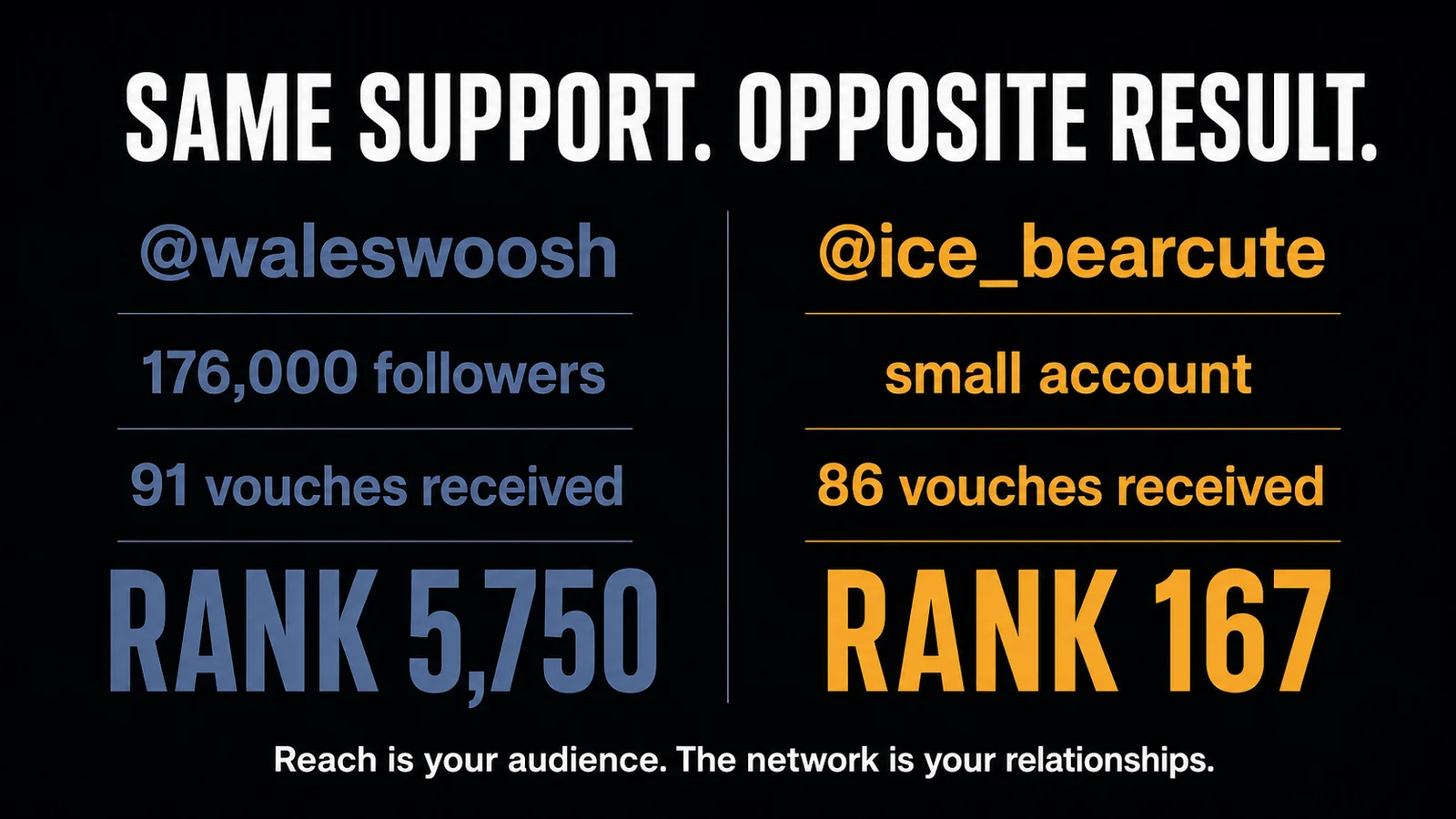
That's not an anomaly, it's the rule, and it comes from the mechanic. A vouch is worth 35% of the giver's base score. So the value of a vouch depends entirely on who casts it, and the spread is enormous. Among accounts that received at least twenty vouches, the best-served got 82,255 points per vouch and the worst-served got 857. Those endpoints imply about a 96x range per vouch (82,255 divided by 857), rather than the 131x stated in the original text. One account collected 140 vouches, more than almost anyone in the entire season, and finished at rank 5,906, because the 140 people who vouched had nothing to give.
So volume of support is close to worthless. Quality of support is everything. And quality here means one specific thing: whether the people who back you are themselves backed.
The reciprocity test makes this sharper. Take every account that received between 16 and 40 vouches, so a fixed band of inbound attention, and split them by whether their own outgoing vouches came back. Accounts with five or more mutual ties finished at a median rank of 1,198. Accounts with one or none finished at 2,945. Within the 16-40-vouch band, mutual ties were associated with a better median rank. The band still contains different vouch counts, point values and other characteristics, so this is an association rather than an isolated causal effect.
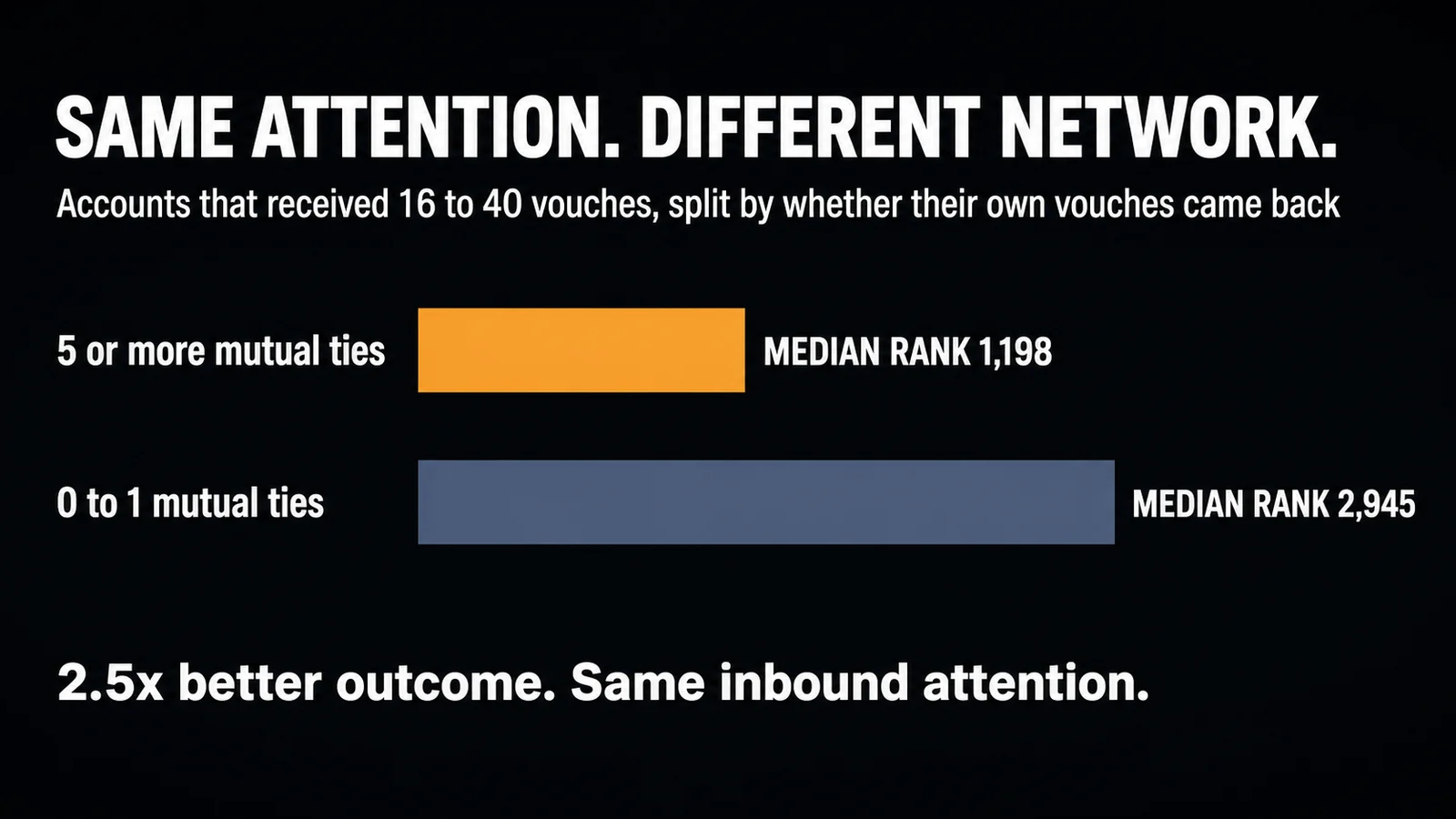
I think the human explanation is simpler than the mechanics. You can be close to twelve people. You can't be close to fifty thousand. An account with a modest following that shows up in the same replies every day, remembers what people are working on, and has actual friendships is holding a dense reciprocal network. A large account is holding a broadcast list. Those are different assets, and until somebody built a game where the only currency was a favour, they looked identical on a profile page.
Commons priced them apart. Reach is a property of your audience. The network is a property of your relationships. The mechanism only paid for the second one, and a lot of people who'd spent years optimising for the first found out what they'd actually accumulated.
One participant worked this out on day three and wrote the best practical takeaway in the whole record: "this project is a reality checker of your current stats of CT! Big kols never gonna help/support you in max time, They have their own friends that they will priorities first So make a circle, it Don't have to be inner circle ct from kaito, but it should be a circle of people you trust."
Big kols never gonna help/support you in max time, They have their own friends that they will priorities first
So make a circle, it Don't have to be inner circle ct from kaito, but it should be a circle of people you trust24 Aug 2026View on X
Who actually won
The account at the top of the leaderboard finished with 12,471,370 points, 1,942 vouches received, 1,146 slashes received, and zero slashes used. @CrypSaf was simultaneously the most loved and most attacked participant in the season, and he never once hit back.
Where did 1,942 vouches come from? Not from a campaign. @CrypSaf runs @0xAlphaGEMs, a curated private community with roughly 197 members and a reputation for being hard to get into. The vouches were loyalty deposits accumulated over years, all maturing inside seventy-two hours. One member mentioned the invite had arrived three years earlier. Another put the sentiment plainly: "He is beloved by everyone and it's built on true merit and hard work."
The community's performance is the number that should bother anyone designing a system like this. @CrypSaf posted it himself: "82 GEMS finished in the Top 1K out of 94,604 participants." Against a baseline of about 1.06%, roughly 41% of the group placed. A fortyfold advantage, held by 0.2% of the field.
Happy to lead such a high-quality squad 💜24 Aug 2026View on X
Nothing about that is cheating. The observed community advantage does not by itself establish cheating, purchases or botting. The action ledger alone cannot rule those explanations out either. Which is the problem. The instrument was built to detect who the crowd values, and it detected exactly that, and what the crowd values turned out to be the thing it valued before the game started.
Bourdieu argued that social capital is convertible into economic capital, and that the conversion is usually invisible because it happens through favours, introductions and access rather than transfers. Commons made the conversion explicit and put a timestamp on every step of it. You can watch three years of community building become 1,942 vouches, and then become a leaderboard position, and then become tokens, in a public ledger with the receipts attached.
Thirty-six thousand three hundred and forty-four
That's how many accounts spent vouches and received nothing back. It's the largest single group in the dataset, sixty percent of everyone who took an action, and it's the one you'd never find from reading the timeline.
Here's what it looked like from inside.
@0xSofiya asked for vouches because it was her birthday: "I don't know what's going on with @commonsmade, but it's my birthday today, so I'm asking you all for a little help. 🥹🎂." An hour later, having spent her own allocation on three large accounts, she apologised for it: "Sorry guys @CrypSaf, @waleswoosh, @Jampzey for taking your points on @commonsmade 🥰."
Read that again. She gave away a permanent, unrecoverable resource to three people, and then apologised to them for the imposition. In a game explicitly framed around generosity, the person doing the giving felt like she'd taken something.
Sorry guys @CrypSaf, @waleswoosh, @Jampzey for taking your points on @commonsmade 🥰21 Aug 2026View on X
Then there's @Bakioption, who finished at 1005. Outside the top thousand by five rank positions in this snapshot. Eighty people had burned a permanent slot on him, and he'd watched the number climb with real optimism the morning before: "you guys really showed up for me ❤️." His post-mortem is the most restrained thing in the dataset: "just missed the top 1K. 🥲 rank #1,004 | 694,756 points. if the snapshot was taken 3 hours later, I might have made it. but anyway, everything is up to luck. ❤️ huge thanks to the 80 people who successfully vouched for me."
Vouching had been frozen four and a half hours before the close. Eighty permanent slots, spent, with a final recorded rank outside the top thousand.
rank #1,004 | 694,756 points
if the snapshot was taken 3 hours later, I might have made it. but anyway, everything is up to luck. ❤️
huge thanks to the 80 people who successfully vouched for me.24 Aug 2026View on X
Now the methodological part, which I think is more interesting than either story. I pulled fourteen named accounts from this cohort, all of them with a leaderboard rank so they should have been findable, and went looking for what they said afterwards. Six of them don't appear in the social index at all, which tells you the measurement floor is real. Of the eight that do, seven posted nothing after the airdrop. Not a complaint, not a joke, not a goodbye.
And not one account in the entire cohort publicly named somebody who took their vouch and didn't return it. Not one. In a dataset containing thousands of people who could have done exactly that, with public receipts available to prove it, nobody did.
The silence is the finding. Whatever this cost people, they mostly chose not to say so in public, which is worth remembering the next time somebody tells you what a community thinks based on what its loudest members posted.
PART III: ENFORCEMENT
A minority weapon, aimed upward
Two numbers, and they're almost the same number by coincidence.
86.3% of participants never used a single slash. And 86.3% of the slashes that were fired went at a target ranked above the person firing.
So the destructive half of the mechanic was ignored by nearly everyone, and the small group that used it aimed up. That combination rules out the simple story. This wasn't a war of all against all. It was a minority behaving aggressively toward people above them, while the overwhelming majority declined to touch the weapon at all. The vouch-to-slash ratio came out at 11 to 1.
Three separate logics show up in what the slashers actually said.
The first is competitive and rational. One participant described it afterwards: "accounts outside the top were slashing ppl at the bottom of the top 1k hoping to take their spot." That works only if you're already sitting at the boundary, and it's the only version where a slash has a return on investment.
The second is moral. @dogacan opened a campaign with an accusation rather than a strategy: "I haven't slashed anyone on Commons. But I don't want a scammer like Kaai on this list. This guy scammed his friends for just $200. He doesn't deserve to be on this list. Hey @commonsmade, slash @Cryptokaai." Note the "just $200" doing the rhetorical work, sizing the offence as contemptible rather than serious, which makes joining in feel cheap. @Cryptokaai ended up with 220 slashes against 232 defensive vouches, the only documented case where a target's own community mobilised back.
Hey @commonsmade, slash @Cryptokaai23 Aug 2026View on X
The third is pure theatre. @Langerius posted "hey @commonsmade, slash @VitalikButerin" at peak intensity. Vitalik wasn't on the leaderboard. The post drew 437 likes. By day three, slashing had entertainment value entirely detached from competition, and the only people who could afford that were the ones whose position was already safe.
Then there's the inversion, which took me a while to understand. People started asking to be slashed.
@0xALTF4 announced the pivot: "fuck the vouch meta I wanna become the most slashed mf on @commonsmade THE SLASH WAR STARTS NOW slash @0xALTF4 SEND EVERYTHING I'm here for the fun now." @Montiweb3 made the economics explicit: "USE YOUR SLASHES ON ME 📢 [...] BEST SLASH WINS MY LAST VOUCH!"
That second one is the actual mechanism. If you've concluded you won't make the top thousand, your slash slots are worth nothing to you and your vouch slot is worth a lot to somebody else. So you auction the worthless thing for attention and pay out the valuable thing as a prize. It's a rational liquidation of a portfolio you can no longer use, dressed as a joke. @MontiMania took 361 slashes, more than any account outside the top ten, and a good portion of them came from friends who'd been asked to do it.
Two communities, two institutions
Here's where the campaign stops being about crypto and starts being about how groups govern themselves.
Two communities used the slash mechanic heavily and visibly, in opposite directions, with the same button. The variable that decided which direction was the social structure each one already had before the button existed.
The Turkish network built a perimeter. @nftmufettisi announced the infrastructure directly: "Yardımlaşma ve haksızlık yapanları cezalandırma telegram grubu kurulmuştur" ("A telegram group has been established for mutual aid and punishing those who do injustice"). A second group ran in parallel: "Coach Alpha geri döndü, TÜRKLER BİRLEŞİYOR" ("Coach Alpha is back, TURKS ARE UNITING"). The framing was explicitly ethnic and explicitly defensive. The standing policy was stated in advance: "Bize haksız yere slash atanları gömdüğümüz gibi birbirimize yardım ederiz, edeceğiz" ("Just as we buried those who unfairly slashed us, we will help each other, we will").
Outsiders noticed. @Carlitoswa_y, a Spanish account with 32K followers, posted a warning that reads like field notes: "Never slash a Turkish guy. He'll insult you, threaten you and send bots your way."
He then finished the season with 209 slashes against him and a leaderboard entry of zero points and no rank. He'd become the case study in his own warning.
The full arc is worth following, because it's the only enforcement event in the dataset where somebody involved changed their mind in public. @Elminselimov5 was the Turkish account at the centre of it. He'd been slashed, he responded, the network mobilised, and @Carlitoswa_y was buried. Then, five hours later, he pulled back: "Arkadaşlar belki de bana kızacaksınız şuan neden böyle karar verdin diye ama bence biraz olayı büyüttüm" ("Friends, you may be angry with me for deciding this, but I think I blew this out of proportion. It turns out the man was going to delete the slash").
The man was going to delete the slash. By then the account was gone.
The South Asian network did the opposite thing. No Telegram group appears anywhere in the record, no ethnic framing, no defensive rhetoric. What it did was expel its own members.
The chain of causation is unusually complete. At 02:50 UTC on 22 August, @Gautamguptagg posted his $1,500 giveaway: $3 per vouch, proof via Telegram DM. Cash for reputation, in a game whose entire architecture existed to prevent exactly that.
Two hours and twenty minutes later, @aryancryptoguy flagged him with a rhetorical question that functions as target designation: "Most slashed people on @commonsmade 👀... But where is my boy @Gautamguptagg?" Four minutes after that, @hrithikk made the recruitment call: "hey @commonsmade slash @Gautamguptagg again have 4 more slash left, tag 4 more cucks to slash."
have 4 more slash left, tag 4 more cucks to slash22 Aug 2026View on X
Again. At least one slash had already landed before the public campaign started.
By 08:34, the call had a queue: "Hey @commonsmade, slash @Gautamguptagg who is next?" By 15:54, the same account had moved to target two. A third account, @VaibhavguptaTF, was added for no reason anyone stated publicly except that @Gautamguptagg had vouched him.
The ledger shows what the timeline can't. 145 accounts slashed at least two of the three targets. 25 slashed all three. All three finished with zero points and no rank.
And the accusation was, on the evidence, correct. @Gautamguptagg confirmed the four hundred paid codes himself. What he never did, including in his final post after being zeroed, was address it: "Enjoy your freaking $20-$100 from commons 🤡 This campaign showed me one thing: you can literally see how quickly some people's character changes when even a 3-4 digit reward is involved. The hypocrisy is unreal." A complaint about other people's character, from the man who'd bought four hundred endorsements at three dollars each.
Set the two side by side and the contrast is total. The Turkish action was outward-facing, announced, organised through named infrastructure, framed around ethnic solidarity, and aimed at anyone from anywhere who touched a member. The South Asian action was inward-facing, unannounced, coordinated through nothing more than public replies, framed around anti-cheating, and aimed at members of the same community. One was a wall. The other was a court.
Elinor Ostrom spent a career documenting how real commons get governed without a state, and two of her design principles are that the community must monitor itself and must be able to sanction violators. Both of these groups produced exactly that, spontaneously, in under seventy-two hours. Nobody instructed them to.
What neither produced were the other principles: defined boundaries, graduated sanctions, and a mechanism for resolving disputes. So the monitoring worked and the sanctioning worked, and what came out the other end was three accounts destroyed without a proceeding, one of them purely for having been vouched by somebody else, and one Spanish participant erased over a slash the slasher had already offered to withdraw.
Self-organised enforcement without due process isn't self-governance. It's a mob with good intentions. The project was called Commons.
What the ledger caught that the timeline hid
This is the section I'd keep if I had to throw the rest away, because it isn't about Commons at all.
When you hold both the record of what people said and the record of what they did, they don't drift apart randomly. They diverge in a specific direction: people talk more aggressively than they act, and the people who act don't talk.
Four cases, all with clean attribution, all checkable.
@nftmufettisi founded the Telegram group for punishing those who do injustice and wrote that his community had "buried" those who slashed them unfairly. His ledger entry: seven vouches given, seven returned, and zero slashes used. The architect of the retaliation infrastructure was, in his own actions, a perfect cooperator who never harmed anyone.
@CrypSaf took 1,146 slashes, more than any account in the season, and used zero.
@walsxbt demanded accountability from everyone else: "We need to hold ALL KOLs accountable who promised to share their airdrops with people who vouched for them. Must provide proof of every $0.05 transaction to all your supporters or you're a LARP." His ledger: six slashes used, five of them mutual, and exactly one reciprocated vouch. The loudest voice for integrity was one of the most aggressive players on the board.
@hrithikk called for slashing @Gautamguptagg and told others to tag four more people to slash. He finished the season having absorbed 221 slashes himself, ninth-highest in the entire dataset.
And @aryancryptoguy, who announced the verdict in public ("the leaderboard just exposed two scammers"), personally slashed all three targets and finished at rank 4,657.
Now the number that makes this structural rather than anecdotal. Of the 38 identifiable participants in that coordinated campaign, three announced their slash publicly. Thirty-five did it silently. The ledger has them. The timeline doesn't.
@Gautamguptagg: -270,991
@shahrianazim6: -908,131
congratulations boys, you're officially out of the race 💀23 Aug 2026View on X
So an analysis built on posts alone would have found three people doing something and concluded it was a small spat between individuals. The real event involved a hundred and forty-five accounts and ended with three people erased. The visible portion understated the actual portion by a factor of roughly fifty.
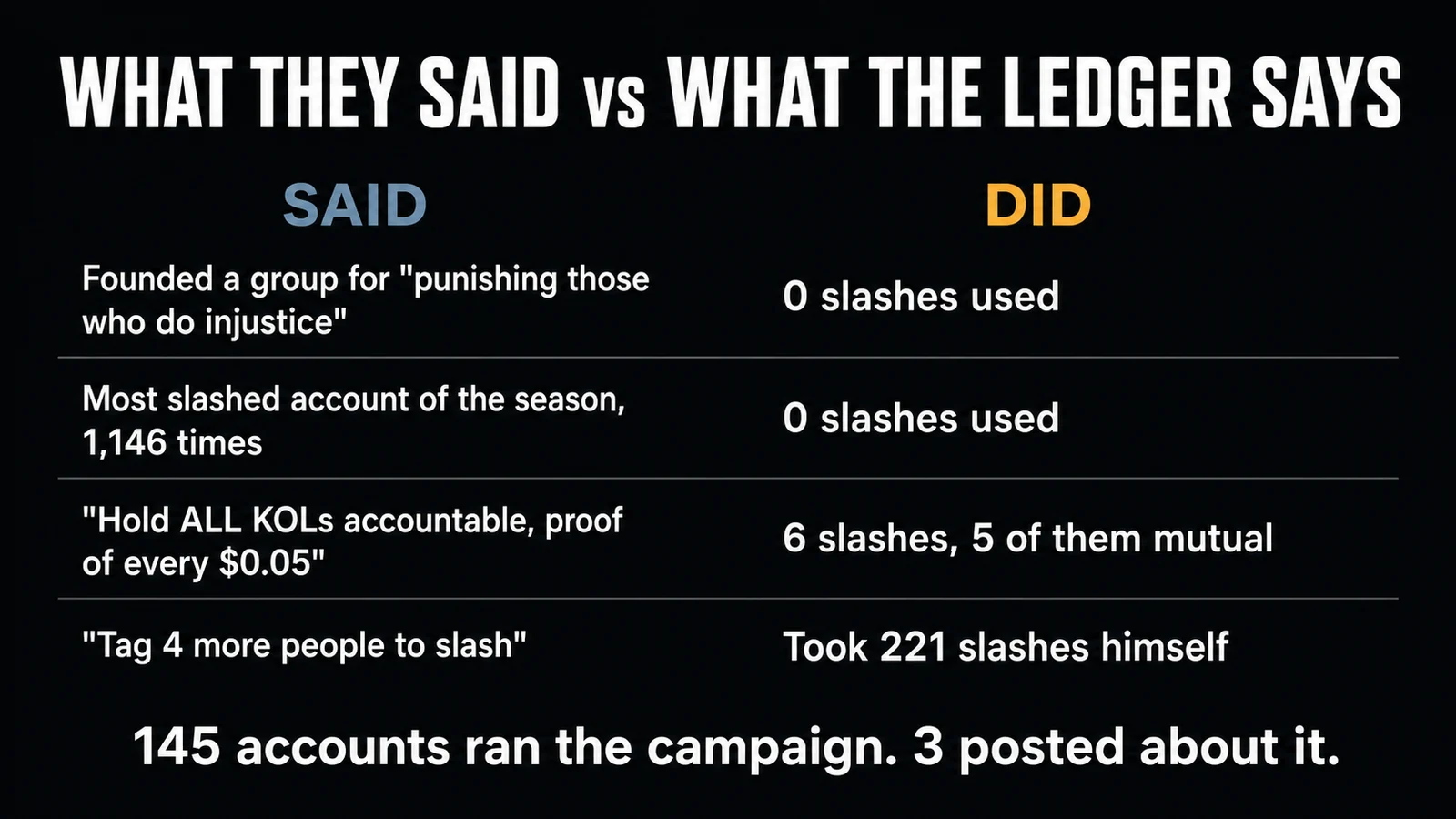
That error isn't random noise you can average out. It runs one way. Loud people are systematically not the ones doing things, which means every study of online behaviour built on discourse alone (and that's most of them, because discourse is what's available) is measuring the announcement layer and reporting it as the behaviour layer.
I don't think this is a small point. Content moderation research, brand sentiment analysis, political polarisation studies, community health metrics: all of them mostly read what people posted, because reading what people did requires a ledger that usually doesn't exist. Commons accidentally produced one, and the answer it gives is that the two layers disagree by a factor of fifty in at least one measurable case.
PART IV: THE END
Twenty dollars
The last day ran on a compressed clock, and the order of events matters.
12:30:20 UTC. @Slayed_eth froze the game: "our devs have been fighting the bots for 12 hours straight. Even with them trapped allowing no new signups, it's been a battle. For now, we're pausing vouching and slashing." Four and a half hours before the close, nobody could give or take anything. Every position on the leaderboard was now final, including @Bakioption's at 1005. The first participant to work out what it meant posted an hour later: "Apparently vouching & slashing are paused on @commonsmade. This could mean our current ranks are already locked in!"
15:41 UTC. The token launched at roughly $4M fully diluted.
15:53 UTC. The airdrop terms: "the first part of everyone's airdrop will be 0.5%. And there will be more to come which will be sustainably dripped over 7 days upon reaching certain market caps."
15:59 UTC. Somebody did the arithmetic in public. Six minutes.
By 16:10 the calculation was everywhere: "Current FDV of $CMNS - $4M. 0.5% of it is - $20000. If split equally between top 1000. That's $20 each. Am I reading this correctly??"
💰 Current FDV of $CMNS - $4M
🔢 0.5% of it is - $20000
🤔 If split equally between top 1000
🤏 That's $20 each
Am I reading this correctly??24 Aug 2026View on X
The reason twenty dollars landed as an insult rather than a disappointment is the comparison everyone had been carrying since day one. @grebby put it in one line: "loudio opened at like 100M~ FDV and everyone got a ~$3.5k airdrop. commonsmade opened at 3M FDV and only 0.5% of supply is claimable. thanks for playing." Expectations had been anchored at $3,500 for three days of work. The payout came in at roughly half a percent of that.
commonsmade opened at 3M FDV and only 0.5% of supply is claimable.
thanks for playing.24 Aug 2026View on X
What followed took about twenty minutes to become the dominant tone on the timeline. @allodev's version is the one that got quoted most: "Entire CT got farmed for a $30 airdrop 😂 Putting that in the books as the best marketing of 2026 got the whole timeline posting for the price of a burger GG WP @commonsmade." @web3righteous, who finished 37th, wrote the rawest one: "$32 for finishing 37 on the @commonsmade leaderboard. guyyyyy I'm logging off😭😭😭 me wey nor sleep for 3 days 😭 everywhere just blurrrrrr……"
Then the promises came due, and this is where the gift economy's paper obligations got settled.
Seven accounts had publicly promised to share 30% or 50% of their airdrop with the people who vouched them. I found no documented payment from these accounts in the sources reviewed for this article. Two couldn't pay because they didn't qualify. One was zeroed. @Alok7765 missed the top thousand and offered a $10 giveaway as consolation: "Commonsmade failed to give us the rewards we were hoping for. I didn't make it into Commonsmade's shitty airdrop." The remaining four qualified and said nothing at all.
@Krptonoob dispatched the whole category with one question: "'i'll share 50% of my Vouch airdrop to my community' how do you plan on sharing $20 to 200 people?"
how do you plan on sharing $20 to 200 people?24 Aug 2026View on X
Which is the honest answer. The promises weren't fraudulent so much as denominated in an expected value that never arrived. Fifty percent of $3,500 across two hundred supporters is eight dollars each, a real if modest thank-you. Fifty percent of twenty dollars is five cents, and there's no dignified way to send five cents to two hundred people.
Then the best detail in the entire aftermath. @CrypSaf, who finished first, gave his whole allocation away: "I'm sharing my $300 full allocation with GEMS who supported us but missed the Top 1K: 10 winners, $30 each (At least they'll get more than the Top 1K allocation 😂)."
He's right, and he knows he's right, and the parenthetical is doing the work. The winner's raffle paid more than actually finishing in the top thousand. Ten people who lost the game received more than the people who won it. Nine hours later, a community member confirmed the number: rank 167, 86 vouches, $30 airdrop.
huge thanks to @CrypSaf for building tools to track vouches and GEMs rank, and @0xAlphaGEMs for support community thru this whole thing 💎25 Aug 2026View on X
The team's response was a change of subject. @Slayed_eth conceded one thing, and it wasn't the airdrop: "We should've been more informational throughout the campaign is my main learning." From there it was accelerators, hackathons, and "Big things coming." The @commonsmade account itself posted nothing after 15:53 on the 24th and hasn't since. As of the last check the seven-day milestone drips hadn't started, and the market cap thresholds that would trigger them were never published.
The token, for the record, launched around $0.004, fell to $0.001, and recovered to about $0.00626.
人情
Rank 80 out of ninety thousand. Ninety-six vouches received. Seven given. Zero returned.
Nobody else in the top hundred has that combination. @liuxiaoling933 was one of the most-vouched accounts of the entire season, spent her whole allocation, and got back nothing at all. On the ledger she's a member of the 36,344, the unreciprocated majority, and by every measure the campaign used, she's a story about waste.
She'd run a proper mobilisation on day two, in Mandarin, with exact instructions and the 2x multiplier code included: "前1000名可以拿空投... 姐们们" ("Top 1000 can get the airdrop... ladies"). She knew the mechanics better than most English-language participants did.
Then, at 16:56 UTC on the last day, an hour after the twenty-dollar arithmetic went public, she posted the only assessment in the record written from outside the game:
参与这次1000名空投项目,最终排名在80,虽说鲁了个寂寞,但是我很知足。一些大哥们,女神们,甚至一年没联系的kol朋友,甚至顶流,在你开口时候,又或者没开口时候,并且名额很珍贵情况下,他们给与了帮助,这才是最大的空投。感谢100多位kol朋友的帮助。空投虽没鲁到,但是我撸到了人情,我认为→值,很值。
"Took part in this top-1000 airdrop project. Final rank: 80. The farming came to nothing, but I'm content. Some big-brother KOLs, goddess KOLs, even KOL friends I hadn't spoken to in a year, even top-tier names, when you asked, and sometimes before you asked, and even though the slots were precious, they helped. That is the biggest airdrop. Thanks to the 100+ KOL friends who helped. I didn't farm the airdrop, but I farmed rénqíng. I think → worth it, very worth it."
人情 doesn't translate cleanly. It's the standing web of favours owed and goodwill held that constitutes a person's real position in Chinese social life, closer to credit than to friendship. You accumulate it slowly, you can call on it, and spending it costs you.
What she did with that sentence is precise. She took 撸, the verb everyone had spent the week using for farming points, and swapped the object. Same action, same effort, different asset recognised on the other side.
I want to be careful not to make this sound like consolation, because I don't think it is. Read it against the ledger. Ninety-six people each burned a permanent, unrecoverable slot on her, several of them accounts she hadn't spoken to in a year, several of them people she never asked. That's ninety-six independent costly signals, which is exactly and only what the mechanism was built to detect. She placed 80th out of ninety thousand on the strength of it.
She's not describing a runner-up prize. She's the one person in the dataset who read the instrument correctly. The number on the leaderboard was a proxy. The thing the proxy pointed at was the ninety-six people, and she noticed the difference between the two and said so in public while everyone around her was calculating dollars.
The mechanism worked. One participant’s public account offered a different way to read the outcome. The available conversation does not tell us how every other participant interpreted it.
PART V: WHAT THIS IS GOOD FOR
Five things worth taking away
If you never touch a crypto product in your life, five findings here survive the context.
1. You can't make a resource non-transactional. You can only push the transaction off the ledger.
Commons blocked the obvious exploit, spending on yourself, and assumed that closed the market. It opened five of them instead: barter, revenue-share contracts, order-book listings, bundling with external goods, and cash at three dollars a unit, plus a secondary market with a quoted price. All inside twenty-four hours.
Scarcity doesn't suppress trade, it's the precondition for a price. The moment your platform creates something scarce, valuable and transferable to others, you've issued a currency, and it will be traded in whatever venue you don't control. Your only real choice is whether that venue is inside your system where you can see it, or in DMs where you can't. Commons chose the second by accident and then spent the last twelve hours of the campaign fighting the consequences with a bot purge and an emergency freeze.
2. A measure of social capital measures the capital that existed before the measurement.
Nobody built a reputation during this campaign. People cashed in reputations they'd built over years. The winning community had a three-year head start and outperformed the field by forty times. The 36,344 who got nothing back weren't outplayed on strategy, they showed up without a network into a game that could only see networks.
This is the trap under every reputation system ever shipped: peer review, citation counts, GitHub stars, Yelp, credit scoring, promotion committees. They're all sold as measuring what you did, and they mostly measure who already knows you. Calling that corruption misses the problem. A proxy behaving exactly as designed is much harder to fix than fraud, because there's nobody to catch.
3. The same sanction produces opposite institutions depending on who's holding it.
One slash button. Two communities. One built a perimeter and punished outsiders who touched its members. The other built a court and expelled its own members for cheating. Neither was in the spec.
If you're designing a mechanism, this is the humbling part: you control the tool, not the institution. What comes out is a function of the social structure that was already there. Ship the same button to two groups and you'll get retaliation from one and due process from the other, and the difference will have been decided before your product existed.
4. Enforcement without procedure is a mob, however good the cause.
Both communities produced monitoring and sanctioning without being asked, which is two of Ostrom's design principles for a functioning commons appearing spontaneously in three days. What neither produced were boundaries, graduated penalties or any way to appeal.
The results: three accounts zeroed with no proceeding, one of them targeted solely for having been vouched by somebody under suspicion. One Spanish participant erased over a slash that the person who called for it later said he regretted, after the slasher had already offered to withdraw it. And the accusation at the centre of the biggest campaign was, as far as anyone can tell, true, which is the uncomfortable part. Getting the verdict right doesn't make it a trial.
If you're building community moderation, the sanctioning power is the easy half and it will emerge on its own. The proportionality and the appeal are the hard half and they never emerge on their own.
5. Analysing what people say gets the answer wrong in a predictable direction.
Three people announced a slash. A hundred and forty-five cast one. The account that built the punishment infrastructure never punished anybody. The most-attacked account in the season never retaliated once. The loudest voice demanding accountability was running mutual-destruction pacts on the side.
Every one of those is invisible from the timeline and obvious from the ledger, and the error has a direction. Talk overstates aggression. Action is quiet. Any research built on discourse alone (which is most research on online behaviour, because discourse is what's collectable) is reading the announcement layer and reporting it as the behaviour layer.
The practical version, for anyone running a community or a brand: your loud users are not a sample of your users. They're a sample of your loud users, and on the evidence here that sample missed the actual event by roughly fiftyfold.
What I'd tell someone building the next one
The instinct behind Commons was right. Reputation that you can only receive, never manufacture, is a better signal than reputation you can grind. I'd build on it rather than abandon it.
Four things I'd change.
Make reciprocity structurally possible at the top, or accept that your leaderboard measures inbound popularity only. The seven-vouch cap meant the most-vouched account could return 0.36% of what he received. Everyone underneath him was giving into a void, and thousands of them knew it while they did it. A budget that scales with what you've received, even sublinearly, would have turned a broadcast into an exchange.
Publish the sanction rules before the sanctions start. Three accounts were zeroed by a combination of community slashing and an opaque internal cleanup. Nobody was told which one did it, on what threshold, or whether it could be contested. If the platform is going to have a final say, that has to be visible from day one, or your community will invent its own court and hold trials without you.
Don't anchor expectations on a comparison you can't match. The whole disaster of the last hour was one number sitting next to another number. Nobody at Commons promised $3,500. The Loudio comparison started circulating on day one and the team never corrected it, so the payout was read against an expectation the project had let stand for three days.
Publish the ledger. This is the one I feel most strongly about, and it costs nothing. Commons generated a complete, honest, public record of how a few hundred thousand favours moved between ninety thousand people. That's a genuinely rare object. Almost every claim in this article exists only because the actions were public and attributable, which meant they could be checked against what people said about them. If more platforms shipped their action logs alongside their leaderboards, a lot of arguments about online behaviour would become empirical questions instead of opinion.
What I couldn't answer
Four things I'd want and don't have.
How many of the 19,170 mutual pairs were arranged in advance. The 2,121 that closed inside a minute are a floor, not a ceiling, and the 6,629 that closed between one and five minutes are genuinely ambiguous. Somebody who'd agreed to a swap by DM would answer in three minutes without any coordination that looks unusual from outside. Only DM access resolves it.
How big the bot problem actually was. My snapshot is post-purge. The most-vouched account fell to roughly 3,679th and came back during the cleanup, so the pre-purge numbers were materially different and only the team has them.
Whether the airdrop-share promises were ever honoured. An on-chain analysis of $CMNS transfers out of top-1,000 wallets in the days after the claim would settle it definitively. That's a separate project and somebody should do it.
Why people betrayed each other. 199 pairs exchanged both a vouch and a slash. I pulled the 21 where both accounts were prominent enough to be searchable and went looking for the fallout. Nineteen of them left no public trace at all. The vouch was public because the game required it. The slash was public for the same reason. The reason for the slash was almost never stated by anyone.
Which is a strange note to end the data on. In a campaign that turned generosity into a public performance and punishment into a spectator sport, the one act nobody was willing to explain was breaking a promise to somebody who'd trusted them.
The full graph of every vouch and slash in the genesis season, including the community structure and reciprocation timings, is published as an interactive map. Every figure in this article that isn't attributed to a tweet comes from that dataset, snapshot 2026-08-24 17:26 UTC. Quotes are verbatim, with translations in brackets, and attributed to the account that owns the linked post.
Reading the graph without overstating it
A mutual pair means that both accounts vouched for each other in the retained snapshot. It does not identify the reason. A short delay is a candidate coordination signal, not proof of a deal. Ranks are ordinal: a median rank of 1,198 versus 2,945 is a difference in position, not a 2.5x increase in rewards or welfare. The snapshot follows cleanup, so deleted actions and excluded accounts limit comparisons with earlier public counts. Reproducing the analysis requires the graph snapshot, field definitions and the grouping rules used for each comparison.